GENERALIZATIONS
- 1893 - A PHYSICIAN
- THE WOMAN IS SELF-CENTERED...
PROVAVELMENTE O
HOMEM ERA UM TIPO PORREIRO
SHE IS THE MOST IMPORTANT THING IN HER
LIFE....OU SEJA NÃO TINHA BÉBÉS NÉ....
PSICÓLOGO ESCOLA VIENENSE 1926 - O
HOMEM NÃO FALA DOS PROBLEMAS OF HUMAN RELATIONSHIP
RESUMINDO
GENERALIZAÇÕES E POLÍTICOS COMO VOMITIVO
SÃO GERALMENTE RESULTADO DE
PROBLEMAS PESSOAIS QUE UTILIZAM UMA ESCAPATÓRIA VIRTUAL NA POLÍTICA DE
CAFÉ.....
1933 A ASCENSÃO DO NSDAP TORNARÁ BERLIM IRRECONHECÍVEL EM 10
ANOS .....
E O GAJO QUE DISSE ISTO ENGANOU-SE SÓ EM DOIS ANOS...
dissabte, 26 de juliol del 2014
AVIAN TUBERCULOSIS DESTROY THE OVARIES OF A CHICKEN UND FROM UNDIFFERENTIATED GERMINAL TISSUES ....SHE HAD GROW TESTIS ....ERGO THE CHICKEN PSYCHOLOGY AND HER SEX HAD CHANGED .....ERGO TUTI GALINHA COM TUBERCULOSE FICAM MACHISTAS ....GENERALIZAÇÃO DO DIA.....ELE FICOU VIVO E FICÁMOS TODOS MAIS POBRES ...É O COMENTÁRIO SALGADO DO DIA...

dimecres, 23 de juliol del 2014
It is quite astonishing to see the great demand there is, both in England and France, for dream-books, and other trash of the same kind. Two books in England enjoy an extraordinary popularity, and have run through upwards of fifty editions in as many years in London alone, besides being reprinted in Manchester, Edinburgh, Glasgow, and Dublin. One is Mother Bridget’s Dream-book and Oracle of Fate; the other is the Norwood Gipsy. It is stated, on the authority of one who is curious in these matters, that there is a demand for these works, which are sold at sums varying from a penny to sixpence, chiefly to servant-girls and imperfectly-educated people, all over the country, of upwards of eleven thousand annually; and that at no period during the last thirty years has the average number sold been less than this. The total number during this period would thus amount to 330,000.-Mummies were of several kinds, and were all of great use in magnetic medicines. Paracelsus enumerates six kinds of mummies; the first four only differing in the composition used by different people for preserving their dead, are the Egyptian, Arabian, Pisasphaltos, and Libyan. The fifth mummy of peculiar power was made from criminals that had been hanged; “for from such there is a gentle siccation, that expungeth the watery humour, without destroying the oil and spirituall, which is cherished by the heavenly luminaries, and strengthened continually by the affluence and impulses of the celestial spirits; whence it may be properly called by the name of constellated or celestial mummie.” The sixth kind of mummy was made of corpuscles, or spiritual effluences, radiated from the living body; though we cannot get very clear ideas on this head, or respecting the manner in which they were caught.—Medicina Diatastica; or, Sympathetical Mummie, abstracted from the Works of Paracelsus, and translated out of the Latin, by Fernando Parkhurst, Gent. London, 1653, pp. 2, 7. Quoted by the Foreign Quarterly Review, vol. xii. p. 415.
- his prophecy seems to have been that set forth at length in the popular Life of Mother Shipton:
“When fate to England shall restoreReturn
A king to reign as heretofore,
Great death in London shall be though,
And many houses be laid low.”
-
The London Saturday Journal of March 12th, 1842,
contains the following:—“An absurd report is gaining ground among the
weak-minded, that London will be destroyed by an earthquake on the 17th
of March, or St. Patrick’s day. This rumour is founded on the following
ancient prophecies: one professing to be pronounced in the year 1203;
the other, by Dr. Dee the astrologer, in 1598:
“In eighteen hundred and forty-two
Four things the sun shall view;
London’s rich and famous town
Hungry earth shall swallow down.
Storm and rain in France shall be,
Till every river runs a sea.
Spain shall be rent in twain,
And famine waste the land again.
So say I, the Monk of Dree,
In the twelve hundredth year and three.”
Harleian Collection (British Museum), 800 b, fol. 319.“The Lord have mercy on you all—The alarm of the population of London did not on this occasion extend beyond the wide circle of the uneducated classes, but among them it equalled that recorded in the text. It was soon afterwards stated that no such prophecy is to be found in the Harleian Ms.
Prepare yourselves for dreadful fall
Of house and land and human soul—
The measure of your sins is full.
In the year one, eight, and forty-two,
Of the year that is so new;
In the third month of that sixteen,
It may be a day or two between—
Perhaps you’ll soon be stiff and cold.
Dear Christian, be not stout and bold—
The mighty, kingly-proud will see
This comes to pass as my name’s Dee.”
1598. Ms. in the British Museum.
Return -
Chronicles of England, by Richard Grafton; London, 1568, p. 106.
Return -
Faerie Queene, b. 3, c. 3, s. 6-13.
Return -
Although other places claim the honour(!) of Mother Shipton’s
birth, her residence is asserted, by oral tradition, to have been for
many years a cottage at Winslow-cum-Shipton, in Buckinghamshire, of
which the above is a representation. We give the contents of one of the
popular books containing her prophecies:
The Strange and Wonderful History and Prophecies of Mother Shipton, plainly setting forth her Birth, Life, Death, and Burial. 12mo. Newcastle. Chap. 1.—Of her birth and parentage. 2. How Mother Shipton’s mother proved with child; how she fitted the justice, and what happened at her delivery. 3. By what name Mother Shipton was christened, and how her mother went into a monastery. 4. Several other pranks play’d by Mother Shipton in revenge of such as abused her. 5. How Ursula married a young man named Tobias Shipton, and how strangely she discovered a thief. 6. Her prophecy against Cardinal Wolsey. 7. Some other prophecies of Mother Shipton relating to those times. 8. Her prophecies in verse to the Abbot of Beverly. 9. Mother Shipton’s life, death, and burial.
-
Let us try. In his second century, prediction 66, he says:
“From great dangers the captive is escaped.“What is this,” a believer might exclaim, “but the escape of Napoleon from Elba—his changed fortune, and the occupation of Paris by the allied armies?”
A little time, great fortune changed.
In the palace the people are caught.
By good augury the city is besieged.”
Let us try again. In his third century, prediction 98, he says:
“Two royal brothers will make fierce war on each other;Some Lillius Redivivus would find no difficulty in this prediction. To use a vulgar phrase, it is as clear as a pikestaff. Had not the astrologer in view Don Miguel and Don Pedro when he penned this stanza, so much less obscure and oracular than the rest?
So mortal shall be the strife between them,
That each one shall occupy a fort against the other;
For their reign and life shall be the quarrel.”
God cannot love,’ says Blunt, with tearless eyes,
‘The wretch he starves, and piously denies.’ …
Much-injur’d Blunt! why bears he Britain’s hate?
A wizard told him in these words our fate:
‘At length corruption, like a gen’ral flood,
So long by watchful ministers withstood,
Shall deluge all; and av’rice, creeping on,
Spread like a low-born mist, and blot the sun;
Statesman and patriot ply alike the stocks,
Peeress and butler share alike the box,
And judges job, and bishops bite the Town,
And mighty dukes pack cards for half-a-crown:
See Britain sunk in Lucre’s forbid charms,
And France reveng’d of Ann’s and Edward’s arms!’
’Twas no court-badge, great Scriv’ner! fir’d thy brain,
Nor lordly luxury, nor city gain:
No, ’twas thy righteous end, asham’d to see
Senates degen’rate, patriots disagree,
And nobly wishing party-rage to cease,
To buy both sides, and give thy country peace.”
Pope’s Epistle to Allen Lord Bathurst.
they knit about their heads certain rolls and braidings of false hair.” At last accident turned the tide of fashion. A knight of the court, who was exceedingly proud of his beauteous locks, dreamed one night that, as he lay in bed, the devil sprang upon him, and endeavoured to choke him with his own hair. He started in affright, and actually found that he had a great quantity of hair in his mouth. Sorely stricken in conscience, and looking upon the dream as a warning from heaven, he set about the work of reformation, and cut off his luxuriant tresses the same night. The story was soon bruited abroad; of course it was made the most of by the clergy, and the knight, being a man of influence and consideration, and the acknowledged leader of the fashion, his example, aided by priestly exhortations, was very generally imitated. Men appeared almost as decent as St. Wulstan himself could have wished, the dream of a dandy having proved more efficacious than the entreaties of a saint. But, as Stowe informs us, “scarcely was one year past, when all that thought themselves courtiers fell into the former vice, and contended with women in their long haires.” Henry, the king, appears to have been quite uninfluenced by the dreams of others, for even his own would not induce him a second time to undergo a cropping from priestly shears. It is said, that he was much troubled at this time by disagreeable visions. Having offended the Church in this and other respects, he could get no sound, refreshing sleep, and used to imagine that he saw all the bishops, abbots, and monks of every degree, standing around his bed-side, and threatening to belabour him with their pastoral staves; which sight, we are told, so frightened him, that he often started naked out of his bed, and attacked the phantoms sword in hand. Grimbalde, his physician, who, like most of his fraternity at that day, was an ecclesiastic, never hinted that his dreams were the result of a bad digestion, but told him to shave his head, be reconciled to the Church, and reform himself with alms and prayer. But he would not take this good advice, and it was not until he had been nearly drowned a year afterwards, in a violent storm at sea, that he repented of his evil ways, cut his hair short, and paid proper deference to the wishes of the clergy.
In France, the thunders of the Vatican with regard to long curly hair were hardly more respected than in England. Louis VII., however, was more obedient than his brother-king, and cropped himself as closely as a monk, to the great sorrow of all the gallants of his court. His queen, the gay, haughty, and pleasure-seeking Eleanor of Guienne, never admired him in this trim, and continually reproached him with imitating, not only the head-dress, but the asceticism of the monks. From this cause a coldness arose between them. The lady proving at last unfaithful to her shaven and indifferent lord, they were divorced, and the kings of France lost the rich provinces of Guienne and Poitou, which were her dowry. She soon after bestowed her hand and her possessions upon Henry Duke of Normandy, afterwards Henry II. of England, and thus gave the English sovereigns that strong footing in France which was for so many centuries the cause of such long and bloody wars between the nations. When the Crusades had drawn all the smart young fellows into Palestine, the clergy did not find it so difficult to convince the staid burghers who remained in Europe, of the enormity of long hair. During the absence of Richard Cœur de Lion, his English subjects not only cut their hair close, but shaved their faces. William Fitz-osbert, or Long-beard, the great demagogue of that day, reintroduced among the people who claimed to be of Saxon origin the fashion of long hair. He did this with the view of making them as unlike as possible to the citizens and the Normans. He wore his own beard hanging down to his waist, from whence the name by which he is best known to posterity.
The Church never shewed itself so great an enemy to the beard as to long hair on the head. It generally allowed fashion to take its own course, both with regard to the chin and the upper lip. This fashion varied continually; for we find that, in little more than a century after the time of Richard I., when beards were short, that they had again become so long as to be mentioned in the famous epigram made by the Scots who visited London in 1327, when David, son of Robert Bruce, was married to Joan, the sister of King Edward. This epigram, which was stuck on the church-door of St. Peter Stangate, ran as follows:
“Long beards heartlesse,
Painted hoods witlesse,
Gray coats gracelesse,
Make England thriftlesse.”
When the Emperor Charles V. ascended the throne of Spain he had no beard.
It was not to be expected that the obsequious parasites who always
surround a monarch, could presume to look more virile than their master.
Immediately all the courtiers appeared beardless, with the exception of
such few grave old men as had outgrown the influence of fashion, and who
had determined to die bearded as they had lived. Sober people in general
saw this revolution with sorrow and alarm, and thought that every manly
virtue would be banished with the beard. It became at the time a common
saying,—Painted hoods witlesse,
Gray coats gracelesse,
Make England thriftlesse.”
In France also the beard fell into disrepute after the death of Henry IV., from the mere reason that his successor was too young to have one. Some of the more immediate friends of the great Béarnais, and his minister Sully among the rest, refused to part with their beards, notwithstanding the jeers of the new generation.“Desde que no hay barba, no hay mas alma.”We have no longer souls since we have lost our beards.
Who does not remember the division of England into the two great parties of Roundheads and Cavaliers? In those days every species of vice and iniquity was thought by the Puritans to lurk in the long curly tresses of the monarchists, while the latter imagined that their opponents were as destitute of wit, of wisdom, and of virtue, as they were of hair. A man’s locks were the symbol of his creed, both in politics and religion. The more abundant the hair, the more scant the faith; and the balder the head, the more sincere the piety.

PETER THE GREAT.
Since that day, the rulers of modern Europe have endeavoured to persuade, rather than to force, in all matters pertaining to fashion. The Vatican troubles itself no more about beards or ringlets, and men may become hairy as bears, if such is their fancy, without fear of excommunication or deprivation of their political rights. Folly has taken a new start, and cultivates the moustache.
Even upon this point governments will not let men alone. Religion as yet has not meddled with it; but perhaps it will; and politics already influence it considerably. Before the revolution of 1830, neither the French nor Belgian citizens were remarkable for their moustaches; but, after that event, there was hardly a shopkeeper either in Paris or Brussels whose upper lip did not suddenly become hairy with real or mock moustaches. During a temporary triumph gained by the Dutch soldiers over the citizens of Louvain, in October 1830, it became a standing joke against the patriots, that they shaved their faces clean immediately; and the wits of the Dutch army asserted that they had gathered moustaches enough from the denuded lips of the Belgians to stuff mattresses for all the sick and wounded in their hospital.
The last folly of this kind is still more recent. In the German newspapers, of August 1838, appeared an ordonnance, signed by the king of Bavaria, forbidding civilians, on any pretence whatever, to wear moustaches, and commanding the police and other authorities to arrest, and cause to be shaved, the offending parties. “Strange to say,” adds Le Droit, the journal from which this account is taken, “moustaches disappeared immediately, like leaves from the trees in autumn; every body made haste to obey the royal order, and not one person was arrested.”
The king of Bavaria, a rhymester of some celebrity, has taken a good many poetical licences in his time. His licence in this matter appears neither poetical nor reasonable. It is to be hoped that he will not take it into his royal head to make his subjects shave theirs; nothing but that is wanting to complete their degradation.
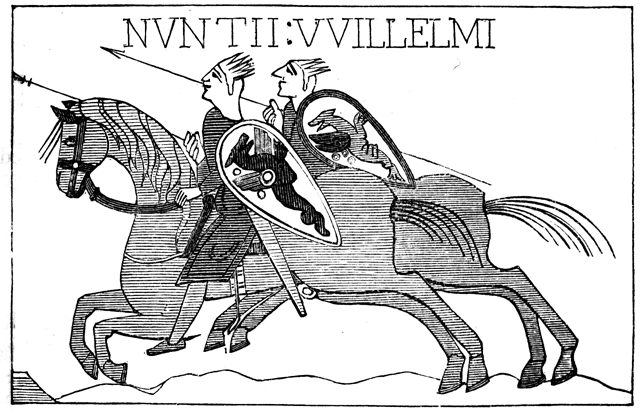 BAYEUX TAPESTRY
Subscriure's a:
Comentaris (Atom)